
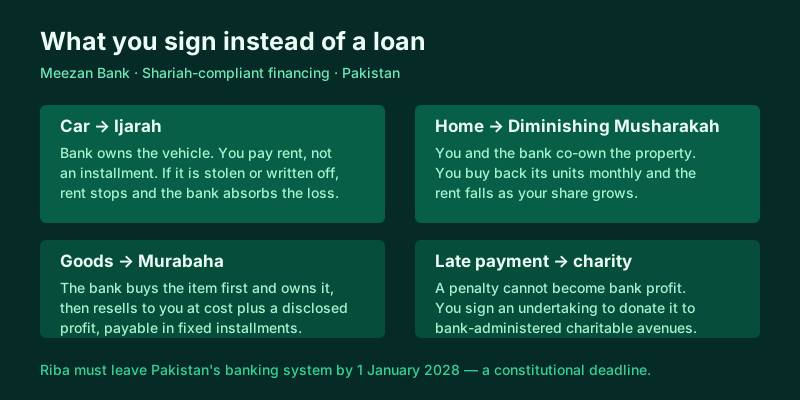

MEEZANLOAN-PK-20260908Meezan Bank does not issue loans, and that is not a marketing line — it changes four things you can check in the contract: who owns the asset while you pay, what happens if you settle early, where a late-payment penalty goes, and who takes the hit if the asset is destroyed. Get those four right and Islamic financing stops being abstract. This also stopped being a niche question: Pakistan has a constitutional deadline of 1 January 2028 to remove riba from the banking system, so these contracts are becoming the default rather than the alternative.
What you actually sign, by need
| What you need | Contract | Who owns the asset during the term |
|---|---|---|
| A car | Ijarah (lease) | The bank. You pay rent for use, not an installment on a debt |
| A home | Diminishing Musharakah | You and the bank jointly; you buy the bank’s units back over time |
| Goods, appliances, inventory | Murabaha | The bank buys and owns them first, then resells to you at cost plus a disclosed profit |
| Working capital | Running Musharakah, Istisna or Salam | A partnership pool, or goods being manufactured or forward-purchased |
The distinction is not academic. Because a Murabaha price is fixed once the sale is executed, the amount you owe cannot move afterwards — there is no floating rate to reprice against you. The trade-off appears when you want to pay early, and that is covered further down.
Car Ijarah: where it genuinely differs from a conventional lease
The bank owns the vehicle for the whole term and you pay rent for using it. That single fact produces the most valuable difference in the product. If the car is stolen or written off, Meezan bears the loss. Rent payments stop immediately, because rent is owed only for an asset you can actually use — the contract is voided rather than continuing to run while an insurance claim is processed. If the claim pays out less than the vehicle is worth, the bank absorbs the shortfall and returns your security deposit.
Practical terms to check before signing: tenure runs from 1 to 5 years for vehicles up to 1000 CC. Cover must be Takaful rather than conventional insurance, arranged through bank-approved operators such as EFU or Adamjee, with rates quoted from 1.99 % of the vehicle value per year and a mandatory tracker. At the end of a standard Ijarah the vehicle is sold to you for a token amount or gifted under a separate contract. Under the Residual Value variant you instead pay an agreed residual of 40 % to 60 % of the original cost to take ownership — or simply hand the car back, which is the point of that variant.
If you are comparing against a conventional arrangement, the honest comparison is total cost across the full term plus who carries the destruction risk, not the headline monthly figure. Our breakdown of Meezan Car Ijarah in detail works through the structure step by step.
Easy Home: buying the bank out, unit by unit
Home financing runs on Diminishing Musharakah. You and the bank purchase the property together under joint ownership, the bank’s share is split into small equal units, you rent the units you do not yet own, and each month you buy some back. As your share grows the rent falls proportionately, until you own the property outright. Two payment shapes exist: the UMI model keeps the unit price constant across the term, while the Step-up model has you buy one unit a month in the first half and two a month in the second, which lowers the early instalments.
| Product | Financing range | Tenure |
|---|---|---|
| Easy Buyer / Easy Builder / Easy Replace | PKR 1 million – 100 million | 3–25 years (2–25 for construction) |
| Renovation financing | PKR 0.3 million – 20 million | 2–15 years |
| Roshan Apna Ghar (non-resident Pakistanis) | PKR 0.5 million – 50 million | 3–20 years |
| Meezan Women First | PKR 0.5 million – 50 million | 3–25 years (20 for businesswomen) |
| Wazir-e-Azam Apna Ghar (subsidised) | up to PKR 10 million | up to 20 years |
The number that decides whether you qualify is not the financing cap but the share you must bring yourself:
The bank finances up to 75 % of the property value for salaried applicants, the self-employed and non-resident Pakistanis, up to 70 % for businessmen and up to 65 % for businesswomen under the Women First segment. Work backwards from that: on a PKR 20 million property a salaried applicant needs PKR 5 million of their own, and a businesswoman PKR 7 million.
The part that costs you more: settling early
This is the trade-off nobody puts in the brochure. Once a Murabaha sale is executed, the amount owed is a fixed debt. Shariah does not allow a discount to be contractually tied to early repayment, so the bank is not obliged to reduce the price if you pay ahead of schedule. Any rebate is granted at the bank’s sole discretion, case by case, and cannot be written into the contract in advance.
The consequence is planning, not outrage: if you expect a windfall — a bonus, a property sale, remittances — a shorter original tenure is worth more to you than a longer one you intend to cut short. In a conventional facility you would compare early-settlement fees; here you compare tenures at the outset, because the exit is not priced in.
A late payment cannot become the bank’s profit
Charging extra on an existing debt is riba, so a penalty cannot flow to the bank. Instead, business customers sign an undertaking at the start to pay any late-payment amount to charity, and those collections are routed to bank-administered charitable avenues and excluded from bank profits. On the consumer side, Meezan’s Consumer Ease facility states no late payment charges at all.
That does not make late payment harmless — the default is still recorded and still affects your standing with the bank. It means the penalty is not a revenue line, which removes the incentive that exists in conventional lending. If you want to see how repayment behaviour is recorded in Pakistan, our guide to checking your credit record covers what lenders actually see.
Where the 2028 deadline actually stands
The Federal Shariat Court took up the matter in February 2022 and gave the federal government a five-year grace period to transition, which parliament then codified into a hard constitutional deadline of 1 January 2028. The transition is real but behind schedule. Islamic banking accounts for about 20 % of Pakistan’s commercial banking system, with assets exceeding PKR 14 trillion by late 2025 — substantial growth, but short of the State Bank of Pakistan’s earlier target of a 35 % share by 2025.
Six full-fledged Islamic banks operate: Meezan, BankIslami, Dubai Islamic Bank Pakistan, Al Baraka, Bank Makramah and Faysal Bank. Most of the large conventional banks have not converted outright but run Islamic windows or branches alongside their conventional business, including Allied Bank’s Aitebar, National Bank of Pakistan, Bank AL Habib and HBL. Meezan itself sells conversion advisory services to conventional banks making the switch, which tells you where the institutional expertise sits.
One unresolved point deserves mention, because it is the most common criticism you will encounter. Pricing on facilities such as Running Musharakah still references KIBOR plus a margin, and the sector has no widely adopted Shariah-compliant benchmark to replace it. Models have been proposed, but none has been standardised across the market. The contracts differ genuinely in ownership, risk and penalties; the benchmark used to set the profit rate does not yet.
Before you apply
Three checks are worth doing in order. First, decide which contract fits the need — an asset purchase points to Ijarah or Murabaha, a property to Diminishing Musharakah, and working capital to a partnership structure. Second, confirm the down-payment share you must fund yourself, since that decides eligibility long before the profit rate matters. Third, look at the full term rather than the monthly figure, particularly if early settlement is likely, because the rebate is discretionary. If you are still weighing options across lenders, our overview of fast personal financing in Pakistan sets out what the alternatives require.