

Short answer: bank home loans in Pakistan are priced at KIBOR plus a spread. With 1-year KIBOR around 12.7% in October 2026 and spreads of 3–4 points, commercial home finance costs roughly 15.7%–16.7% a year. The cheaper route for first-time buyers is the government's Apna Ghar programme, formerly "Mera Ghar – Mera Ashiana". Since March 2026 it lends up to PKR 10 million at a fixed 5% for the first 10 years, over up to 20 years, with 10% down payment and no processing fee. From year 11 the rate switches to 1-year KIBOR + 3%. The SBP's August 2026 rules allow home loans of up to 30 years and 90% of the property value, with repayments capped at 65% of your net income.
PKHL1510This guide covers today's rates, the subsidised scheme, what the main banks offer, how Islamic home finance differs from a conventional loan, the documents and extra costs, and a worked example of what you would pay each month.
How home loan rates are set in 2026
Almost all home finance in Pakistan floats with KIBOR, the Karachi Interbank Offered Rate, plus a fixed bank margin. The SBP policy rate drives KIBOR. The State Bank cut the policy rate to 10.5% around the turn of 2026, raised it by 100 basis points to 11.5% in late April 2026 after an oil-price shock, and has held it there since, most recently on 14 September 2026. The next Monetary Policy Committee meeting is due on 26 October 2026. On the KIBOR fixing of 9 October 2026, the 1-year offer rate was 12.73%; on 12 October, the 6-month offer was 12.42%.
| Bank and product | Type | Pricing for salaried applicants | Maximum tenure | Maximum financing |
|---|---|---|---|---|
| Meezan Bank Easy Home | Islamic | 12-month KIBOR + 3.0% (businesspeople + 4.0%) | 25 years | 75% of value (65–70% for businesspeople) |
| HBL HomeFinance | Islamic | 1-year KIBOR + 3.0% to 3.2% | 25 years | 70% |
| UBL Address | Conventional | 1-year KIBOR + 3.5% (self-employed + 4.0%) | 20 years | Around 75–80% |
| Bank Alfalah Home Finance | Conventional | 1-year KIBOR + 3.0% (self-employed + 4.0%) | 25 years | 80% |
| MCB Home Loan | Conventional | 6-month KIBOR + 2.0% to 3.0%, lower with more equity | 25 years | Tiered by down payment |
| BankIslami MUSKUN | Islamic | Quoted at branch | 25 years | 85% for professionals, 80% for businesspeople |
These terms come from the banks' product pages and schedules published in 2026. Bank limits are often tighter than the SBP maximums: the regulator allows 30 years and 90% financing, but most commercial products stop at 20–25 years and 70–85%. MCB lowers its margin as your down payment rises: KIBOR + 3% under 30% equity, + 2.5% from 30%, + 2% from 50%. A bigger deposit therefore cuts both the loan and its rate.
Apna Ghar (Mera Ghar – Mera Ashiana): the 5% scheme
The SBP launched "Mera Ghar – Mera Ashiana" on 24 September 2025 to replace the earlier Mera Pakistan Mera Ghar programme. Two changes in 2026 made it much more useful:
- 17 March 2026 (SBP circular letter 01 of 2026): the loan cap rose from PKR 3.5 million to PKR 10 million. Eligible homes grew to houses up to 10 marla and flats up to 1,500 sq ft. The two rate tiers (5% and 8%) were replaced by a single fixed 5%, applied retrospectively to earlier 8% loans.
- 1 April 2026: the scheme was renamed the "Wazir-e-Azam Apna Ghar Program – Ghar Ho Tu Apna". Banks use both names.
| Feature | Apna Ghar terms (2026) |
|---|---|
| Who qualifies | First-time homeowners with CNIC; non-resident Pakistanis with NICOP or POC |
| Loan amount | Up to PKR 10 million; no cap on the property price |
| Rate | 5% fixed for years 1–10; 1-year KIBOR + 3% for years 11–20 |
| Tenure | Up to 20 years |
| Financing ratio | 90% bank, 10% buyer |
| Fees | No processing fee and no prepayment penalty |
| Uses | Buy a ready house or flat, build on your own plot, or buy a plot and build |
Banks set their own income floors for the scheme, typically PKR 25,000 to PKR 40,000 of net monthly income. In September 2026, the SBP clarified that employees of participating banks can use it only on normal commercial terms. Demand is far ahead of delivery. By 14 October 2026, reported approvals reached about PKR 448 billion across some 75,000 applications, but only about PKR 76 billion had been disbursed. The Prime Minister told banks on 10 October 2026 to clear the backlog. Expect paperwork and waiting times, and keep your documents complete.
What you would pay: a worked example
Take PKR 5 million over 20 years. Under Apna Ghar, the first ten years at 5% cost about PKR 33,000 a month. After 120 payments you still owe about PKR 3.11 million. If 1-year KIBOR + 3% is still around 15.7% then, the payment for years 11–20 rises to about PKR 51,600. The same loan at a commercial 15.73% from day one costs about PKR 68,550 a month for all 20 years.
In total, the subsidised loan costs about PKR 10.2 million over 20 years against PKR 16.5 million for the commercial one. Plan for the year-11 jump, though. Under the SBP's 65% debt-burden cap, a PKR 33,000 payment needs about PKR 51,000 of net monthly income, while PKR 51,600 needs about PKR 79,000. Our figures assume today's KIBOR stays unchanged; it will not, so treat years 11–20 as an estimate.
آمدنی کا ثبوت، جیسے تنخواہ کی پرچیاں یا بینک اسٹیٹمنٹ۔The SBP rules every lender follows
The SBP issued updated Prudential Regulations for Housing Finance on 18 August 2026 (SH&SFD Circular No. 04):
- Tenure: up to 30 years for housing; renewable-energy add-ons up to 10 years.
- Loan-to-value: up to 90%, so at least 10% down payment.
- Debt burden: all your monthly loan repayments together may not exceed 65% of net disposable income. Banks must use the Pakistan Banks' Association proxy models to assess informal income.
- Valuation: above PKR 10 million, an independent PBA-panel valuer is required; up to PKR 10 million, banks may value internally.
- Simpler security (Circular No. 06, 9 October 2026): documentation is limited to title papers, and for loans up to PKR 5 million banks can mark a lien on digital land records, such as a PLRA property certificate, instead of registering a full mortgage.
Islamic vs conventional home finance
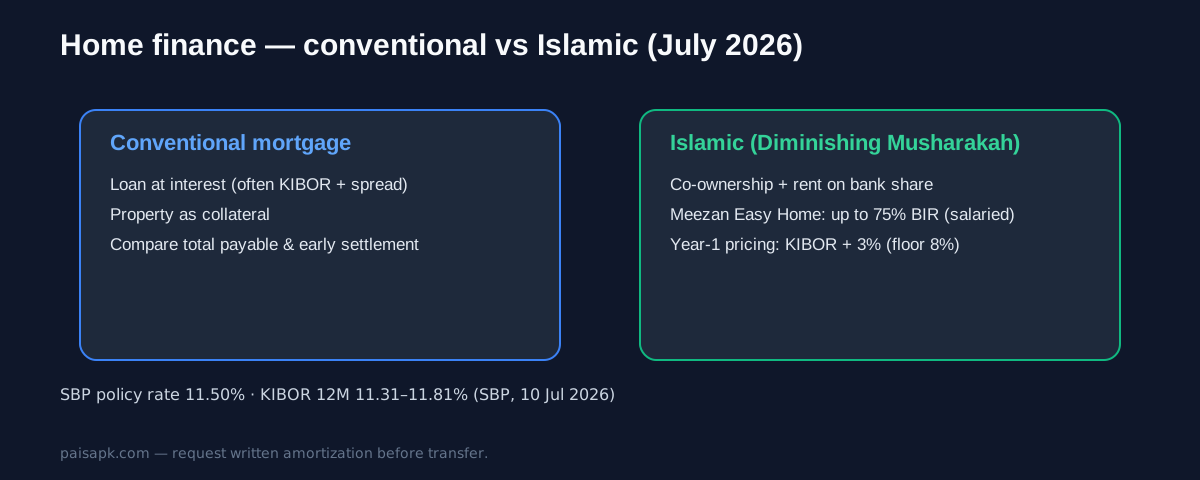
Islamic banks use Diminishing Musharakah. You and the bank buy the house together, for example 20% you and 80% the bank. You pay rent for the bank's share and gradually buy its units until you own the whole property. Each unit you buy shrinks the bank's share, so the rent falls over time. The pricing still uses KIBOR plus a margin, which Shariah boards accept as a benchmark, so monthly costs end up close to a conventional loan's. The real differences are elsewhere. Late-payment charges go to charity rather than to the bank's income. Early settlement works by buying the remaining units, sometimes at a small premium. And because it is co-ownership, rent stops if the property is totally destroyed before takaful pays out.
Documents and extra costs
Banks now use standard application forms: green for salaried, blue for business and pink for informal income. Typical documents:
- Salaried: CNIC, photos, last three salary slips, employment certificate, 6–12 months of bank statements, a recent utility bill and the property papers.
- Self-employed: CNIC, two to three years of business proof (tax returns, NTN, partnership deed or company forms) and 12 months of statements. People with informal income can use rent agreements, utility, telecom or school-fee bills as proxies.
- Overseas Pakistanis: passport, CNIC or NICOP, a residence or work permit, salary proof, 6–12 months of statements and a credit report from the country of residence. They can apply through Roshan Digital Accounts under Roshan Apna Ghar. If you send money home for the down payment, compare fees in our guide to sending money to Pakistan.
Budget for costs on top of the down payment:
- Valuation, about PKR 15,000–30,000.
- Legal and title search, about PKR 10,000–20,000.
- Bank processing fee, about PKR 10,000–15,000 plus federal excise duty on commercial loans; waived under Apna Ghar.
- Mandatory property insurance or takaful, often 0.15%–0.25% a year.
- Stamp duty and registration.
- Taxes on the purchase: the capital value tax and the advance tax on property purchases. The advance tax is far higher for non-filers than for active taxpayers, so register as a filer before buying.
For a personal loan instead of a mortgage, see our guide to applying for a personal loan online.
ملکیتی دستاویزات، اگر لاگو ہوں۔ (Property documents, if applicable.)