
What is a Home Loan in Pakistan?
A home loan helps people buy homes. Banks call it housing finance. This credit supports many needs. You can buy an existing house. You can build a new one. You can also renovate your home. Or you can extend it. This loan offers financial support.
The State Bank of Pakistan (SBP) sets rules. These are Housing Finance Prudential Regulations. Banks must follow these rules. Financial institutions also follow them. They make sure loans are fair. They protect borrowers.
Banks can finance existing homes. They can also fund new construction. This applies to land you already own. You can get money for renovations. You can also transfer an old home loan. This helps manage your debt better.
SBP rules limit loan amounts. Banks can finance up to 85%. This is called Loan-to-Value (LTV). You must pay the remaining 15%. This equity ensures you have a stake. It also reduces bank risk.
Construction finance works in stages. Banks disburse money step by step. Each step ties to construction progress. This ensures money is used right. It also helps manage project funds. Banks check work before releasing money.
Banks must limit real estate exposure. This is another SBP rule. It caps property investments. Exposure cannot exceed 10%. This prevents too much risk. It keeps the banking system stable. Banks follow these limits carefully.
Property valuation is a must. Banks need approved valuers. These valuers assess property worth. This ensures the collateral value. It protects both the bank and borrower. The SBP requires this process.
Banks Offering Home Loans in Pakistan
Many banks offer home loans. These include conventional banks. Some also offer Islamic finance. They follow SBP regulations. They help Pakistanis buy homes. Each bank has its own terms.
Major banks in Pakistan provide these loans. Habib Bank Ltd (HBL) is one. United Bank Ltd (UBL) also offers them. MCB Bank and Allied Bank Ltd (ABL) are options. National Bank of Pakistan (NBP) helps people too.
Islamic banks provide Sharia-compliant options. Meezan Bank offers Islamic home finance. Bank Islami is another choice. HBL also has an Islamic option. These cater to different borrower needs. They follow Islamic finance principles.
Loan tenures vary by bank. Some loans last 15 years. Others can extend up to 25 years. This affects your monthly payment. Longer tenures mean lower monthly payments. Banks like ABL offer 3-25 years. UBL offers 3-20 years.
House Building Finance Company (HBFC) is another option. It is a specialized institution. HBFC offers conventional loans. Their tenure is typically 3-20 years. They focus on housing finance. They help many home buyers.
Home Loan Eligibility and Application
You need to meet some rules. Eligibility criteria change by bank. Pakistani citizenship is usually required. Non-resident Pakistanis (NRPs) can apply. They need a NICOP for this process. Banks check your nationality.
Age limits apply to borrowers. You must be at least 21-25 years old. Your age at loan maturity also matters. It cannot exceed 60-65 years. Banks check these age requirements. This ensures repayment capability.
Income is a key factor. Banks set minimum income levels. HBL requires PKR 100,000 per month. UBL needs PKR 150,000 per month. These thresholds ensure you can pay back. Your income must be stable.
Employment history is important. Banks check your job tenure. You might need 2 years with one employer. This shows job stability. It assures banks of your income source. Self-employed people need business proof.
Debt-to-Income ratio has limits. This ratio cannot exceed 45-50%. It measures your debt against income. Banks want to see low debt. This shows you can manage new payments. It is a critical financial check.
You can apply with a co-applicant. This helps combine incomes. It can increase your eligible loan amount. A co-applicant shares responsibility. They also need to meet criteria. This option makes loans easier to get.
The application process starts with pre-qualification. You check your eligibility first. Banks have online calculators. You can estimate your monthly payment (EMI). This helps plan your finances. It gives you a clear idea.
Next, you submit your forms. You fill a standard application. You give your CNIC or NICOP. You provide proof of income. Bank statements for 6-12 months are needed. Employment or business proof is also required.
Property valuation follows. The bank orders an appraisal. Approved valuers check the property. They assess your repayment capacity too. This process follows SBP housing regulations. It ensures proper asset assessment.
After checks, you get approval. The bank sends an offer letter. This letter details the loan amount. It states the tenure. It also shows the markup rate. You review these terms carefully.
The final steps involve legal work. You sign mortgage documents. Then the loan gets disbursed. For purchases, it's often a lump sum. For construction, funds come in tranches. These tranches match construction stages.
Interest Rates and Loan Terms
Loan costs vary by provider. Markup rates depend on the bank. Conventional loans use KIBOR as a base. KIBOR means Karachi Interbank Offered Rate. Banks add a spread to KIBOR. This spread can be 2.00% to 4.00%.
UBL Address offers conventional loans. For salaried people, it's KIBOR + 3.50%. For self-employed, it's KIBOR + 4.00%. The rate is floating. It revises yearly based on KIBOR. This means your rate can change.
MCB Home Loan is conventional. It uses 6-Month KIBOR. The spread is between 2.00% and 3.50%. Higher equity can lower the spread. This rewards a larger down payment. MCB offers tiered rates.
Bank Alfalah offers conventional loans too. Their rate is KIBOR + 2.00% to 3.00%. They have no maximum loan cap. They allow flexible balloon payments. This gives borrowers more payment options.
| Provider | Product Type | Markup Rate Basis | Typical Spread or Fixed Rate | Processing Fee |
|---|---|---|---|---|
| HBL Islamic Home Finance | Diminishing Musharakah | 12-month KIBOR + 3.00%-4.00% | Floating rental rate 12.50%-13.67% | Per Islamic Schedule of Charges |
| UBL Address | Conventional | KIBOR + 3.50% (Salaried) / +4.00% (SEP) | Floating annual revision linked to KIBOR | Typically 0.50%-1.00% of loan |
| MCB Home Loan | Conventional | 6-Month KIBOR +2.00%-3.50% | Tiered by equity: lower spread with higher equity | Minimal (bank-specific) |
| Bank Alfalah | Conventional | KIBOR +2.00%-3.00% | No maximum loan cap; flexible balloon payment option | 1.00% of loan (min. PKR 10,000) |
| Meezan Bank Easy Home | Diminishing Musharakah | Profit rate on Musharakah partnership | Up to PKR 100 million; tenure 25 years | No hidden charges |
| HBFC | Conventional | 1 Year KIBOR +3.00% / PKRV +4% | Ghar Sahulat: subsidized by SBP; yearly repricing | Zero processing under subsidy scheme |
| NBP | Conventional | KIBOR +3.00%-4.00% | Government-backed Mera Pakistan Mera Ghar (3%-5%) | Nil under subsidy scheme |
| Allied Bank (ABL) | Conventional | KIBOR +3.00% | Loan up to PKR 40 million; prior 6-month banking relationship required | Bank-defined |
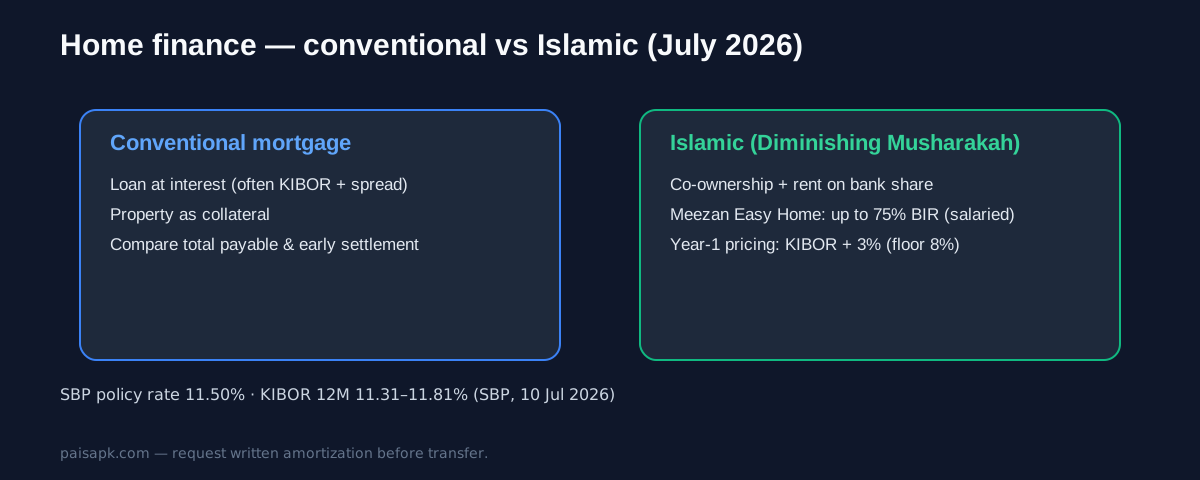
Islamic options use different terms. HBL Islamic Home Finance uses Diminishing Musharakah. Its basis is 12-month KIBOR + 3.00%-4.00%. The rental rate floats between 12.50%-13.67%. Meezan Bank Easy Home uses a profit rate. It is based on a Musharakah partnership. It has no hidden charges.
Processing fees also vary. UBL charges 0.50%-1.00% of the loan. Bank Alfalah charges 1.00% of the loan. This is a minimum of PKR 10,000. MCB's processing fees are minimal. HBFC has zero processing fees under subsidy.
Government schemes offer support. NBP offers Mera Pakistan Mera Ghar. This scheme has subsidized rates. The rates are 3%-5% for the first 10 years. It also has nil processing fees. HBFC Ghar Sahulat is also SBP subsidized.
Step-by-Step Home Loan Application
First, assess your money situation. Use online EMI calculators. They help you find your loan capacity. You determine the loan amount needed. You also decide on a suitable tenure. This initial step is very important.
Next, choose your financing type. You can pick conventional loans. Or you can choose Islamic options. Consider your beliefs and financial needs. Both types have distinct features. Make an informed decision.
Then, select a bank and product. Compare different markup spreads. Look at processing fees. Check for SBP subsidy schemes. Some banks offer special incentives. Shopping around helps you find the best deal.
Gather all necessary documents. You need your CNIC or NICOP. Collect salary slips or audited accounts. Bank statements for several months are vital. Have your property ownership papers ready. A valuation report may also be needed.
Submit your application. You can do this online. Or you can visit a bank branch. Ensure all forms are complete. Attach all required documents. A complete application speeds up the process.
Follow up with the bank. They might ask for more details. Respond to their queries promptly. Provide any extra documents requested. Stay engaged throughout the process. This helps keep things moving.
Receive your sanction letter. Review all the terms carefully. Check the loan amount and interest rate. Understand the repayment schedule. Once satisfied, sign the mortgage deed. This finalizes your loan agreement.
Loan disbursement occurs next. For property purchase, funds are often lump-sum. For construction, money comes in tranches. These tranches release against progress certificates. This ensures construction milestones are met. Your loan repayments start after disbursement.
Required Documents and Procedures
Identification is key for your loan. You need your CNIC. If you are an NRP, provide your NICOP. Co-applicants also need their identification. These documents confirm your identity. They are mandatory for all banks.
Proof of income is essential. Salaried individuals need salary slips. Provide the last 6 months of slips. A salary certificate from your employer is also vital. This verifies your regular income. Banks use it to assess repayment capacity.
Self-employed individuals need different proofs. Provide audited financial statements. Submit tax returns for the last 2-3 years. These show your business income. They help banks understand your financial health. Banks need stable income proof.
Bank statements are also required. Provide statements for the last 6-12 months. These show your transaction history. They prove your financial stability. Banks check for consistent income. They also look for regular expenses.
Employment proof is needed. Submit your appointment letter. A certificate from your company is also helpful. This confirms your job status. It verifies your employment tenure. It adds credibility to your application.
Property documents are critical. You need the title deed. Allotment letters are important. The building plan must be submitted. Provide land registry papers. A No-Objection Certificate (NOC) may also be required.
A valuation report is mandatory. The SBP sets thresholds for this. For loans up to PKR 10 million, one valuator is enough. For loans above PKR 10 million, two valuators are needed. This ensures accurate property assessment. Banks rely on these reports.
Benefits, Risks, and Considerations
Home loans offer many benefits. They enable home ownership. You do not need full upfront capital. This makes buying a home possible. Loans bridge the financial gap. Many people achieve their dream this way.
Longer repayment tenures help. They reduce your monthly EMI burden. You pay less each month. This makes budgeting easier. You can spread costs over many years. This flexibility is a big advantage.
Subsidy schemes exist. They offer lower rates. These schemes target low-income groups. Mera Pakistan Mera Ghar is one example. They make home ownership more affordable. These programs are very helpful.
However, risks are present. Interest rates can fluctuate. This happens with variable rate loans. Your monthly payments might increase. This adds to your financial burden. It is an important risk to consider.
Watch out for high fees. Processing fees can be significant. There might be hidden charges too. Always ask for a full breakdown. Compare fees across different banks. Understand all costs involved.
Property valuation shortfall is a risk. The bank's valuation might be lower. This can create a funding gap. You might need to pay more equity. Ensure you understand valuation methods. Be prepared for this possibility.
Consider fixed versus floating markup. Fixed rates offer payment certainty. Your EMI stays the same. Floating rates may start lower. But they can change over time. Choose based on your risk tolerance.
Check prepayment penalties. Some banks charge for early settlement. This fee reduces your savings. Compare these charges beforehand. Understand terms for closing your loan early. This can save you money.
Insurance is often mandatory. Banks require life insurance. Property insurance is also usually needed. These protect the bank and you. Factor these costs into your budget. They are part of the loan package.
Recent Updates and Market Trends
The SBP updates regulations. Prudential Regulations 2026 changed things. The microfinance housing limit rose to PKR 5 million. This helps smaller loans. It supports more low-income borrowers.
Mortgage tax credits were restored. This provides tax relief. It makes home loans more attractive. Borrowers can save on taxes. This incentive supports home ownership. It reduces overall costs.
Land-only financing has new rules. It is capped at 50% of the loan limit. This prevents speculative buying. It promotes actual construction. Banks must follow this new cap. It ensures responsible lending.
Government subsidies are strong. The Mera Pakistan Mera Ghar Scheme helps. It offers financing at 3%-5%. This is for the first 10 years. It also has zero processing fees. This scheme targets various income levels.
Interest rate cycles influence loans. SBP policy rate is currently 11%. This follows 1,100 bps cuts since June 2026. Lower rates stimulate mortgage demand. They make loans more affordable. This boosts the housing market.
Green mortgage incentives exist. Pakistan Mortgage Refinance Company (PMRC) offers this. You get a 0.25% rebate. This applies to energy-efficient homes. It promotes sustainable building. It rewards eco-friendly choices.
Expert Tips for Home Loan Success
Consider a fixed-rate loan. This is smart if rates are volatile. It locks in your monthly payment. You avoid future rate hikes. This provides financial peace of mind. Your budget remains stable.
Build an emergency fund. Aim for 6 months of EMIs. This fund covers unforeseen events. It protects you from missed payments. Do this before getting a loan. It creates a safety net.
Use balloon payments carefully. They can lower your EMI. But they require a lump-sum later. Balance lower EMIs with future obligations. Plan these payments wisely. Ensure you can meet them.
Shop around for loans. Even small rate differences matter. A 0.25% difference can save money. Over 20 years, savings are substantial. Compare offers from various banks. Find the most competitive rate.
Leverage subsidy schemes. Low- and middle-income groups should apply. SBP subsidy schemes offer great rates. Apply promptly for these benefits. They make home ownership affordable. Do not miss these opportunities.
Common Home Loan Problems and Solutions
Loan rejection can happen. It might be due to low income. A solution is to add a co-applicant. Their income combines with yours. You can also increase your equity. This reduces the LTV ratio needed.
High EMI burden is a concern. This means monthly payments are high. Opt for a longer tenure, up to 25 years. This spreads payments over more time. You can also switch to Islamic financing. Some profit-sharing models might help.
Valuation discrepancy causes issues. The bank's valuation may differ. You can get a second valuation. Negotiate the bank's LTV limit. You might need to supplement your equity. This covers any funding gap.
Rate resets impact variable loans. Your interest rate can change. If rates rise, your EMI increases. You can refinance to a fixed-rate product. Or top-up your loan under new terms. This can stabilize your payments.
Delayed disbursement for construction is common. This holds up building progress. Provide a detailed construction schedule. Use SBP-approved disbursement milestones. Ensure they are in your agreement. This helps manage expectations and funds.
This guide helps Pakistani home-buyers. It gives detailed, current information. You can navigate housing finance options. Optimize your loan terms effectively. This guide also helps to mitigate risks. Make informed home buying choices.

