
Pakistan's Financial Hub

Education Loans in Pakistan: A Practical Guide

8 min read Updated Mar 13, 2026
Fatima Shaheen
Fatima Shaheen

Digital Finance Expert

Digital Finance Specialist focusing on mobile payments and fintech solutions in Pakistan

What is an Education Loan?

An education loan funds academic expenses. It helps students pay for school. It covers tuition fees. It also pays for books. These are core study costs.

Living costs are often included. This can cover accommodation. Daily expenses also count. Study abroad loans pay for travel. They also cover visa fees. This makes international study possible.

Pakistani banks offer these loans. Microfinance institutions also help. NGOs and government schemes provide funds. Borrowers repay principal and interest. Repayment starts after a grace period.

The grace period begins post-graduation. It can also start after first employment. This allows students to secure jobs. It reduces immediate financial stress. This helps students focus on studies.

Who Offers Education Loans in Pakistan?

Many institutions offer student financing. Commercial banks are major providers. Habib Bank Limited offers education loans. United Bank Limited also provides these loans. Muslim Commercial Bank and Allied Bank Limited are other options.

National Bank of Pakistan helps students. Bank Alfalah and Standard Chartered offer loans. JS Bank also provides funding. These banks serve many students. They have wide branch networks.

Islamic banks offer Sharia-compliant products. Meezan Bank uses Murabaha and Ijarah. BankIslami also provides Islamic financing. These options meet religious needs. They follow specific financial principles.

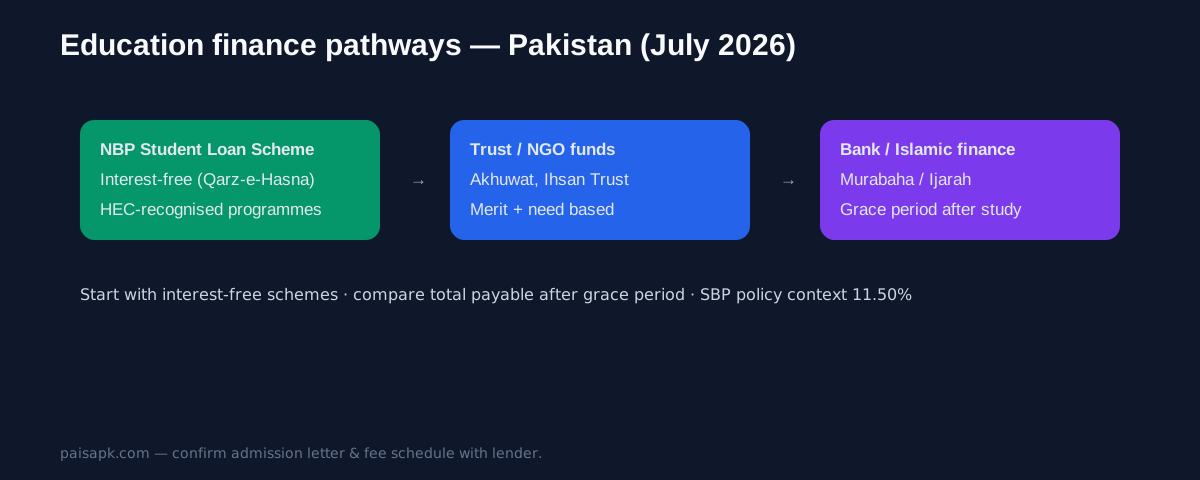
Microfinance groups support students. Kashf Foundation offers small loans. Akhuwat Foundation gives interest-free loans. Ihsan Trust also helps students. These groups focus on broader access.

The Student Loan Scheme (SLS) is a government program. NBP administers this scheme. HBL, UBL, MCB, and ABL partner in it. It offers interest-free loans. This is for meritorious students. It helps deserving individuals.

Private platforms exist for international study. EduFi helps with foreign loans. MPOWER Financing requires no collateral. It offers fixed 9.99% APR. These platforms offer specific solutions for global education.

Eligibility and Application Steps

Applicants must be Pakistani citizens. Expatriates with a CNIC also qualify. You need an admission offer. The institution must be HEC-recognized. This applies to local and foreign schools. This ensures quality education.

Applicants need to meet age criteria. Typically, you must be 18 to 60 years old. Income criteria are also important. HBL requires PKR 25,000 monthly income. Banks set their own income limits. Your income proves repayment ability.

A co-borrower or guarantor is often needed. They must have good creditworthiness. Conventional banks commonly require this. It adds security for the loan. This helps secure loan approval.

The application process is straightforward. First, obtain a loan application form. You can find it at a bank branch. Many banks offer online portals. Complete the form accurately and fully.

Next, submit required documents. You need your CNIC. An admission letter is mandatory. Provide the fee structure. Academic transcripts are also needed. These show your academic background.

You must show proof of income. Salary slips work for employees. Bank statements verify funds. Proof of residence is also vital. A utility bill serves this purpose. These confirm your living situation.

Co-borrower documents are also required. Their CNIC and financial papers are needed. Banks then assess your application. They do a credit evaluation. Collateral is verified if required. This ensures loan security for the bank.

Approval follows successful assessment. Funds are then disbursed. The money goes to the student. It can also go directly to the university. This covers the student's educational expenses.

Loan Rates, Fees, and Terms

ProviderTypeInterest RateProcessing FeeTenureGrace Period
NBP SLSGovernment (Qarz-e-Hasna)0%NilUp to 10 years6 months post-employment or 1 year post-graduation
HBLConventionalBase + 0.5-4.0% p.a.1-2% of loan7-15 years6 months post-graduation
UBLConventional10.5-14% p.a.1.5% of loanUp to 12 years6 months post-graduation
MCBConventional10-12% p.a.1% of loanUp to 10 years6 months post-graduation
Meezan BankIslamic (Murabaha)9.5-12% p.a. (fixed)1% of loanUp to 10 years6 months post-graduation
Bank AlfalahConventional10.25-13.75% p.a.1.5% of loanUp to 10 yearsPost-study grace period
Kashf FoundationMicrofinance12-15% p.a.Nil12-18 monthsNone
Akhuwat TrustNGO (Qarz-e-Hasna)0%NilFlexiblePost-graduation start

NBP Student Loan Scheme charges 0% interest. It has no processing fee. The repayment tenure is up to 10 years. A grace period applies. It is 6 months post-employment or one year post-graduation.

HBL charges interest from Base + 0.5% to 4.0% p.a. Processing fees are 1-2% of the loan amount. Tenure ranges from 7 to 15 years. A 6-month grace period is common. It starts after graduation.

UBL charges 10.5% to 14% p.a. interest. Their processing fee is 1.5% of the loan. Loan tenure is up to 12 years. They also offer a 6-month grace period. This period is after graduation.

MCB charges 10% to 12% p.a. interest. A 1% processing fee applies. The repayment period is up to 10 years. A grace period of 6 months is standard. This is usually post-graduation.

Meezan Bank offers Islamic Murabaha financing. Interest rates are 9.5% to 12% p.a. This rate is fixed. A 1% processing fee is charged. Tenure is up to 10 years. A 6-month grace period applies after graduation.

Bank Alfalah charges 10.25% to 13.75% p.a. A 1.5% processing fee applies. Tenure is up to 10 years. Bank Alfalah provides a post-study grace period. This gives students time before repayments start.

Kashf Foundation charges 12% to 15% p.a. It has no processing fee. Repayment tenure is 12 to 18 months. There is no grace period here. Akhuwat Trust offers 0% interest. They do not charge processing fees. The tenure is flexible. Repayment starts post-graduation. This is a Qarz-e-Hasna option.

Essential Documents and Procedures

Applicants need specific documents. Your CNIC or Form-B is required. Provide your admission letter. A clear fee structure is also needed. Submit your academic transcripts. These prove your study background.

Proof of income is mandatory. Salary slips show employment. Bank statements verify funds. Proof of residence is also vital. A utility bill works for this. These confirm your living situation.

Co-borrower documents are important. Their CNIC is needed. Financial documents are also required. Provide photographs. A signed application form is essential. Ensure all signatures are present.

The procedure is generally standard. However, it may vary slightly. Different bank branches have small differences. Always confirm with your chosen bank. This ensures smooth processing. Read all instructions carefully.

Benefits, Risks, and Considerations

Education loans offer many benefits. They provide access to higher education. Students avoid upfront costs. This helps pursue academic dreams. It opens new academic paths for many.

Repayment tenures are flexible. Grace periods give time. Islamic financing offers competitive rates. These options suit different needs. They support diverse student groups.

However, risks exist with loans. Accrued interest increases total repayment. This means you pay back more. Collateral or guarantee obligations are serious. You might lose assets if you default.

Loan default damages your credit score. It can also lead to legal action. Borrow wisely to avoid these issues. Understand your repayment capacity. Plan your finances carefully before committing.

Many considerations apply. Opt for fixed rates. This helps if currency is volatile. Factor in processing fees. Hidden fees also increase costs. Always ask for a full cost breakdown.

Choose reputable lenders. They offer transparent terms. Read the fine print carefully. Understand prepayment penalties. Check floating-to-fixed conversion options. These details save money later.

State Bank of Pakistan (SBP) promotes financial inclusion. They mandate simplified loan applications. Standardized disclosure is also required. This helps borrowers understand terms. It protects student interests.

HEC asks universities for guidance. They must inform students. Guidance on financing options is key. This helps students make informed choices. It connects them to available resources.

Fintech platforms are growing. EduFi offers digital processing. MPOWER provides faster solutions. These platforms streamline applications. They often use online systems for convenience.

Shariah-compliant options are also rising. Government focuses on Qarz-e-Hasna. This is for deserving students. NFIS 2026-28 supports these schemes. It aims to broaden financial access.

Expert Tips and Solutions

Maintain a strong academic record. This helps access government schemes. Interest-free options are available. NBP SLS is one example. Good grades unlock these benefits for students.

Negotiate processing fees. Ask for fee waivers. Banks may offer promotions. Compare the total cost of a loan. Look beyond the headline rate. This includes all charges.

Total cost includes interest. It also covers fees. Insurance costs are part of it. Consider blended financing. Use part scholarship and part loan. Blended financing minimizes debt.

Read the fine print on penalties. Understand prepayment rules. Check floating-to-fixed options. These details save money later. Always ask questions for clarity.

Common problems can arise. Delayed disbursement is one issue. Track your application status online. Escalate to the branch manager. This can speed things up for you.

High interest burden is another problem. Refinance to a lower-rate provider. Switch to an Islamic product. Meezan Bank offers fixed rates. This helps manage repayment costs.

Collateral disputes occur sometimes. Use government schemes. Many require no collateral. Akhuwat Trust is one example. This avoids pledging your assets.

Complex documentation can be challenging. Use bank relationship managers. Education financing consultants also help. They simplify the process. They guide you through paperwork efficiently.

Repayment difficulties might happen. Request restructuring from lender. Ask for a payment holiday. SBP borrower protection guidelines exist. Use these guidelines for support. Seek help early if needed.

Share this article

Comprehensive Guide to Education Loans from Pakistani Banks

Applicants must be Pakistani nationals enrolled in a recognized institution, meet minimum academic requirements, and demonstrate repayment capacity under State Bank of Pakistan guidelines.

Most banks offer online application portals where you can submit required documents, track your application status, and receive updates electronically.

Typical documents include admission letter, fee invoice, proof of identity and residence, academic transcripts, and guarantor details as per SBP regulations.

Banks may charge a one-time processing fee, usually a small percentage of the sanctioned amount, disclosed upfront in the loan schedule.

Maximum limits vary by bank and program but generally range up to PKR 2 million for local studies and higher for approved foreign programs.

Several Islamic banking windows offer Qard Hasan or Diminishing Musharakah structures under SBP’s Islamic financing framework.

Repayment tenures typically span 5 to 10 years, with grace periods aligned to course duration plus six months.

Collateral requirements depend on loan size; smaller loans may require a guarantor, while larger amounts often need tangible collateral.

Interest rates are set by each bank within the SBP’s prescribed range, and may be fixed or variable depending on the chosen product.

Eligible expense coverage can include tuition, living stipends, and travel allowances, subject to bank-specific limits and SBP approval.

Upon approval, funds are released directly to the educational institution or student account in installments as per the fee schedule.

Yes, many banks require a co-applicant or co-signer, typically a parent or guardian, to strengthen credit standing.

Deferral may be granted for the full duration of study plus a grace period, subject to bank policy and SBP guidelines.

Currency rates can be viewed in the exchange rates section on the bank’s portal or the State Bank of Pakistan website.

Related Articles

Loan Amortization Guide Pakistan

This guide helps Pakistani borrowers use loan amortization calculators. Learn about EMIs, bank offers, and SBP rules for loans in Pakistan. Make informed borrowing choices.

Dec 5, 2025

Fastcash in Pakistan: Simple Guide

Fastcash is an instant money service in Pakistan. It helps people get cash quickly. No bank account is required. This guide explains how it works. It covers banks, fees, and collection steps.

Dec 5, 2025

Pakistan Small Cash Loan Guide

This guide helps you understand small cash loans in Pakistan. It covers major banks, how to qualify, interest rates, and the application process. Learn about benefits, risks, and important tips.

Dec 4, 2025

Business Credit Guide for Pakistani Enterprises

This guide helps Pakistani businesses understand credit. It covers SBP rules and bank offers. Learn about loan types and application steps. Get financing for your business needs.

Dec 2, 2025